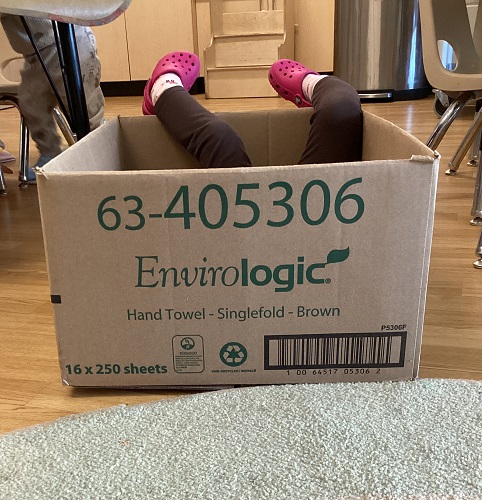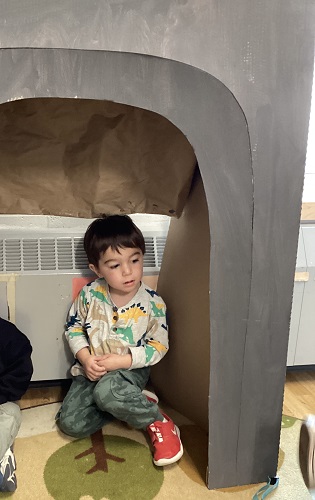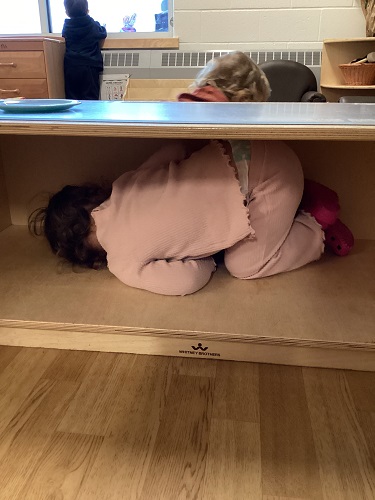


This month we have noticed the toddlers looking for places to climb into, squish into, and hide in. We first noticed their interest near the end of October; they kept asking for the shelf near the window to be pushed out a bit so they could go in behind it. As soon as the shelf was pulled forward a foot or so, everyone would run over and want to squish in behind. We knew we needed some more opportunities for this type of play, so we brought in a box, cleared out the space under our bench, and moved some furniture to create a more closed in corner in the room. We jumped at every opportunity to offer some cozy spots for the children to ‘envelope’ or ‘enclose’ themselves in. One day, we heard that the infant team had made a bear cave and asked to use it. We hid away inside it and later, crawled behind it. The toddlers even created their own opportunities; one day we were using our soccer net as a basketball net and before we knew it, the children were climbing inside the net.
This type of exploration falls under play schemas called enveloping and enclosing. “Play schemas are repeated patterns of behavior that children use to explore and make sense of the world through play.” (google.ca) As an example, climbing in and out of a box allows the children to work on gross motor skills like balance and coordination. They work on knowing how high they need to lift their legs as they step over the side, how the box moves when they push it, and if they can see out of the box if they sit down inside it. Squishing themselves into it helps them understand how their body fits and feels within it, and gives them a different perspective of their environment. Suddenly, they don’t see what is going on around them, they can only see up and out of the box. And the noise around them might sound different as well. Perhaps this enclosure provides a sense of calm and they learn they can find spaces like this when they feel frustrated or overwhelmed.
We look forward to exploring more opportunities similar to these and wonder how the children will interact with what we offer.