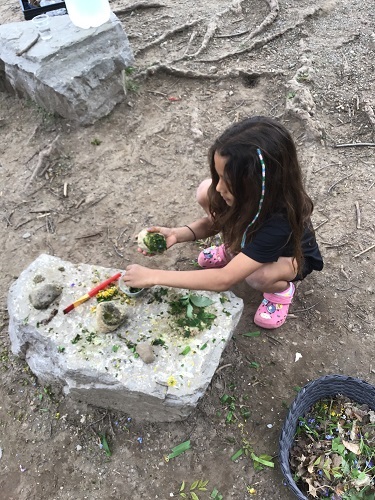
What began as a conversation in the mud kitchen sparked weeks of inquiry, experimentation, and creativity. While using rocks and sticks to crush natural materials for their "soups," one child shared that “back in the day” people used to make paint from flowers and grass. Curious about this idea, the educators asked, "How do you think they did that?" This simple question ignited a rich discussion as children shared theories, built upon one another's ideas, and expressed their thinking. Through these conversations, the children demonstrated their growing ability to communicate knowledge, ask questions, and collaborate with peers.
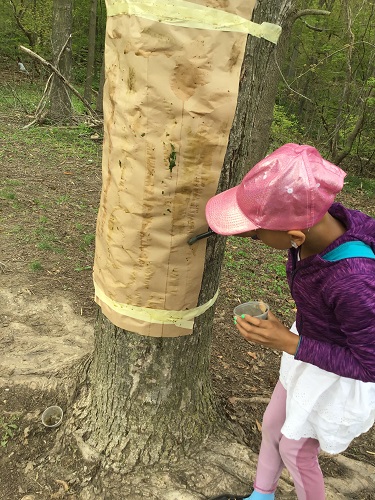 Together, the children and educators planned a walk through the forest to collect colourful natural materials. As they explored, the children gathered purple flowers, yellow dandelions, green grass, and blue flowers, carefully considering which items might
 create the most vibrant colours.
"We will need rocks to mash the flowers!" one child suggested.
During their exploration, the children demonstrated impressive prior knowledge and a strong sense of confidence in sharing their ideas. When a child asked what chlorophyll was, another explained, "It's the colour we see in the plants and that's what we mush to create the colourful paint."
The children's connection to the natural environment was evident as they worked together to investigate the materials around them. Their shared exploration fostered a sense of belonging, as they learned from one another and contributed unique perspectives to the group's inquiry.
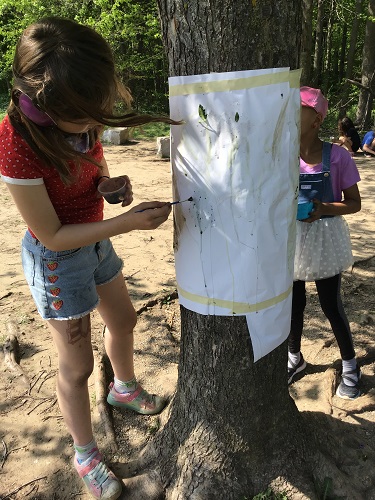
Back outdoors, the educators provided bowls, water, paintbrushes, mortar and pestles, and a large piece of brown paper attached to a tree. The children enthusiastically crushed their collected materials, mixed them with water, and began painting. As they observed the results, they quickly realized that their natural paints were not producing the vibrant colours they had expected.
"The green isn't showing up!"
"The purple looks brown!"
Although disappointed, the children remained engaged in the process. Rather than giving up, they began reflecting on their observations and proposing solutions.
"We need to try this with white paper."
This willingness to revisit their ideas and adapt their thinking demonstrated perseverance, problem-solving, and critical thinking. The children were actively constructing knowledge through hands-on exploration and experimentation.
The following day, white paper was introduced, allowing the children to test their theories. Through careful observation, they discovered that the colours appeared much more vibrant on a lighter surface. They also noticed how dirt and mixed materials affected the paint colours, leading them to refine their collection methods and become more intentional in their work.
"Look at this, I used purple flowers and added a bit the blue flowers and it actually looks blue!"
 "I wonder what it would look like if we mixed some of this purple with yellow?"
The inquiry evolved as children began testing colour combinations, making predictions, and comparing results. They shared discoveries with one another, strengthening their collective understanding while building confidence in their ability to think like scientists and artists. As they explored, they also noticed how some natural materials remained attached to the paper, creating unexpected textures and three-dimensional effects.
As educators reflected on the children's sustained engagement, questions emerged. Was the excitement connected to being outdoors? Were the children drawn to the natural materials, the opportunity to experiment, or the unique textures they were creating? To explore these possibilities further, educators introduced a variety of painting invitations using tempera paint and unconventional tools such as bubble wrap, forks, straws, toothbrushes, and tin foil.
The children eagerly experimented with the materials, sharing discoveries and encouraging one another to try new techniques.
"Wow, look at this! I put too much paint on the bubble wrap—it looks like a blob."
"Check this out! If you don't put too much paint on it, you can see the circles!"
The collaborative nature of the experience encouraged children to learn from one another, build relationships, and celebrate different approaches to creativity. Educators observed that even children who do not typically gravitate toward creative experiences were deeply engaged, suggesting that the open-ended nature of the experience and the opportunity to explore texture invited participation from a wider range of learners.
To continue the investigation, acrylic paint and textured watercolor paper were introduced.
"This paper is bumpy."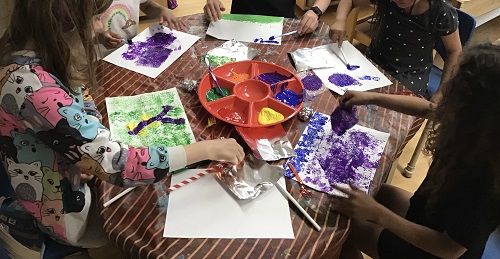
"Look, when I use a little bit of paint, you can see the bumps."
"This paint is thicker. It doesn't spread across the paper as easily as I thought."
The children carefully compared the characteristics of different painting mediums, noticing how the thickness of acrylic paint affected blending, spreading, and texture. Through sensory exploration, observation, and discussion, they developed a deeper understanding of the properties of various art materials. The children demonstrated confidence in taking risks, trying unfamiliar techniques, and learning through trial and error.
The exploration culmin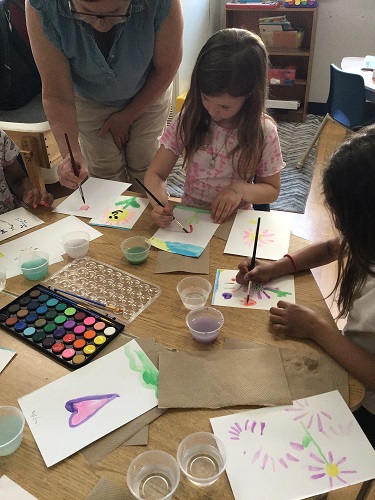 ated with a special watercolor workshop led by guest artist Darlene. The children learned techniques such as wet-on-wet, wet-on-dry, and dry-on-wet painting. They practiced brush control, experimented with how water changes paint movement, and used their new skills to create flowers, plants, animals, and imaginative scenes.
"Wow, when you put water on the paper first, you only have to put a tiny dot of paint on the wetness and it spreads all around!"
"Look at my petal! It looks like a real flower!"
The children's concentration, creativity, and persistence were evident as they refined their techniques and shared their accomplishments with peers. Their artwork became another form of expression, allowing them to communicate ideas, emotions, and discoveries in meaningful ways.
To celebrate their learning journey, the children helped create an art gallery showcasing their work. Families were invited to view the collection, and the children proudly shared their discoveries, explaining the tools, materials, and techniques they had used throughout the process. One word consistently emerged in these conversations: texture. The children had developed a deep appreciation for how different materials, surfaces, and artistic techniques can transform an artwork.
This inquiry highlights how meaningful learning unfolds when children are given time to follow their curiosity, revisit ideas, and learn alongside one another. Through exploring natural paint, experimenting with different artistic mediums, and sharing their discoveries with peers and families, the children strengthened their sense of belonging within the group, expressed their thinking in a variety of ways, demonstrated confidence and resilience when faced with challenges, and remained deeply engaged in a process driven by wonder and discovery. As educators, we are left wondering: What other materials, textures, and artistic processes might inspire the children's next creative inquiry?