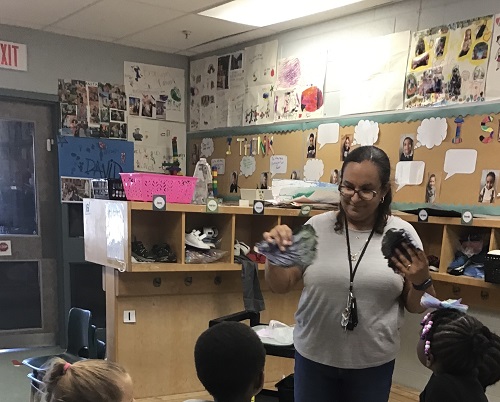
Our curious school age minds are often very intrigued when their educators provide different science experiments. Educator Judy shared her past school age experience with educators Janeth and Graziella, to then share with the children.
It consisted of using purple cabbage leaves. “Is that cabbage?” Geetan asked. “Yes, it is,” educator Janeth replied. “What are we going to do with that?” Braya asked looking confused. Janeth explained that we were going to let the cabbage sit in boiled water for about to 10 minutes, then we would be conducting an experiment with the ingredients that were brought in.
While we waited for the cabbage to sit in the water, Cari suggested we should set a timer so we know when the 10 minutes were up. “Great idea,” the rest of the children agreed.
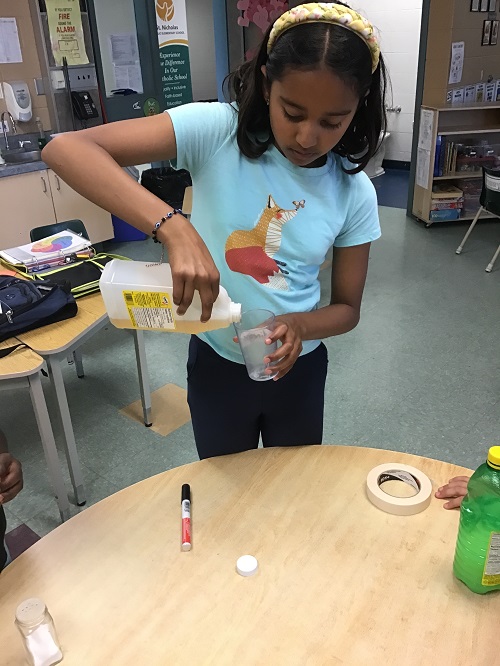
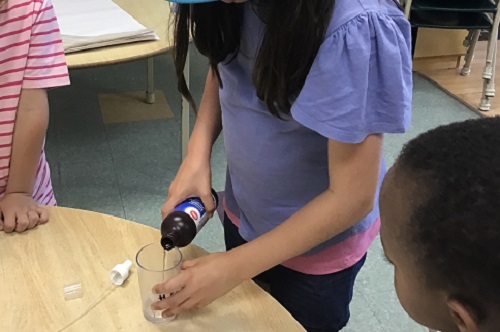
“What ingredients do we have here?” Janeth asked. “That’s salt,” Cari answered. “I have vinegar, “Geetan followed, “But why is it brown? I have vinegar too?” “that’s why it’s a different kind of vinegar, it’s called Apple Cider Vinegar,” Janeth explained. “Well what’s this brown bottle?” Olivia asked. Both her and Geetan tried to read the bottle. “Hydrogen Peroxide? What’s this for?” they asked. Janeth explained that it us used for cleaning wounds, cuts and abrasions and that it can help heal. “Janeth, I don’t have a cup or anything to pour,” Moyosola observed. “Oh, don’t worry, when the timer goes, I have a special job for you.” Her eye lit up with this new information.
Educator Janeth then began to ask the children to pour some of their ingredient into the plastic cups. We labeled each one and were anticipating what we the next step would be. Janeth then asked, “What do you think will happen if we pour the hot cabbage water into these ingredients?” Predictions began to be made, and we created a chart with some of our answers. We have posted the chart in the hallway leading to the school for you to see some of our predictions.
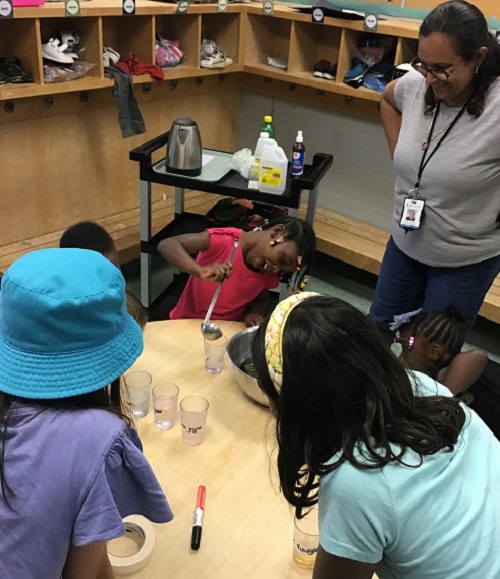
The timer rang and Moyosola quickly took her position. “What am I going to do Janeth, I heard the alarm.” “Well, you are going to pour the cabbage water into the cups and we will observe what will happen,” Janeth replied. “Something smells weird,” said Braya. “Well, what do you think it is?” Janeth asked. “Maybe the water,” ZDami suggested. They all took turns smelling the cabbage water and agreed, “Eeeww.” Moyosola braced the smell and grabbed the ladle to pour water into the cups. Olivia waited in anticipation as she was hopeful that her ingredient would make the water fizz.
“I see it changing colour,” Cari said. “I wonder what colour mine will make?” Geetan asked. “Here comes mine,” said Olivia. “Awe, it did not fizz,” she observed with a sound of disappointment in her voice. The children watched and waited while each cup changed a slightly different light colour. “This is neat,” said Moyosola with excitement.
This science experience allowed for the children to make predictions, observe cause and effect, wait for the results to occur and work together to conduct the experiment. It supports cognitive development, curiosity and social interactions with peers.
As the days went on, Samuel noticed the chart in the hallway with the pictures of his peers doing the experiment. “Graziella, can we do that again?” He asked. We wonder what will happen next when we try again, and maybe use different ingredients such as baking soda or sugar. What reaction or surprise will we experience?