Early this week, Nidya had brought in two trays of eggs for the children to explore. Each egg had a different emotion drawn on it. At one point, a group of children noticed the faces and began talking about it. During their discussions, Nidya noticed some confusion about some of the facial expressions. This inspired her to extend this topic through the Zones of Regulations to help children understand their feelings and emotions.
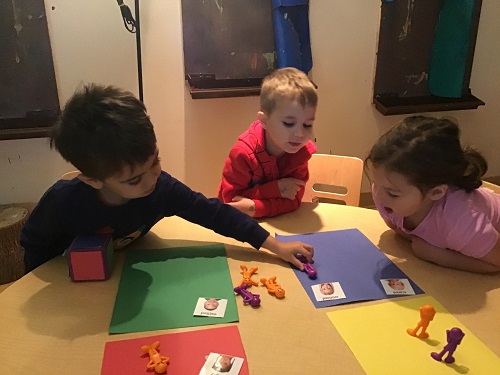
One morning, Nidya set up the round table with the four colours from the Zones of Regulation red, green, blue and yellow.
“Who knows what the colours mean?” Nidya asked the group of children seated at the table. Colin was the first one to respond “Red means stop,” he said. It seems that this association led the children to connect the colours with traffic lights as Rose added “green means go,” and Benjamin said “yellow says wait.” “That is right,” Nidya replied, “what does blue mean then?” She asked. It took only a few seconds before, Sadie said “sad.”
Now that Sadie had mentioned a feeling, Nidya followed up “if blue is sad, then what emotions do the other colours represent?” “Red is angry like this,” said Liam while furrowing his eyebrows, narrowing his eyes, and tightening his mouth.
The group quickly identified the meaning of the green colour, but were unsure about the yellow one. Here, we talked about emotions such as silly, excited, frustrated, and nervous.
Now with a clear understanding of the topic, Nidya explained that they were going to take turns rolling the dice and they would have to find the picture with the emotion based on the colour the dice showed.
After going through the pictures, Nidya also brought out small figurines. These ones are one coloured and they all have six emotions. Children’s first instinct was to match the figurines with their colour without paying attention to the facial expressions. Nidya then asked them to observe them again. Penelope then pointed that one red figurine was actually happy. Together they tried to rearrange the figurines to match the emotions and not the colours.
The feelings/emotions such as, angry, sad, sick, happy, upset and calm were easier for the children to sort. The green, blue and red paper colours filled up quickly, while the yellow zone remained empty. It seems that since these emotions aren’t as strong as the others, they get mixed or forgotten.
To finalize our experience, Nidya asked each child who participated to share how they were feeling and why.
“I am happy because my mom dropped me off here,” said Rose almost immediately.
“I am sad,” said Sadie “because I want mommy.” “I am happy,” said Colin and Liam explained “because my mom will pick me up I am angry I want to play,”. “I am sad.” Benjamin responded “I want to go outside,” he added. “I am good,” Birdie said, but when Nidya asked why, she just repeated “I’m just feeling good.”
“I am sick,” said Hannah and coughed a few times. This triggered a wave of “sickness” for everyone at the table as most of them started to cough as well. “Oh, now you are all feeling sick!” Nidya observed. “Not me! Rose exclaimed, “I am still happy.”
Recognizing and labeling their feelings is a challenge for all preschoolers. They continuously feel invaded by many emotions that it is difficult to express. That is why self-regulation is one of the skills we continually work on in Preschool Two.