In the beginning of May the children prepared for Mother’s Day, we started with a hands-on baking experience making tea biscuits together. During our group discussion, we worked collaboratively to identify the ingredients we would need: flour, milk, baking powder, salt, and shortening. To encourage sensory exploration, we passed around the shortening in a Ziplock bag so the children could squish it, observe its texture, and describe what they noticed relating it to butter.
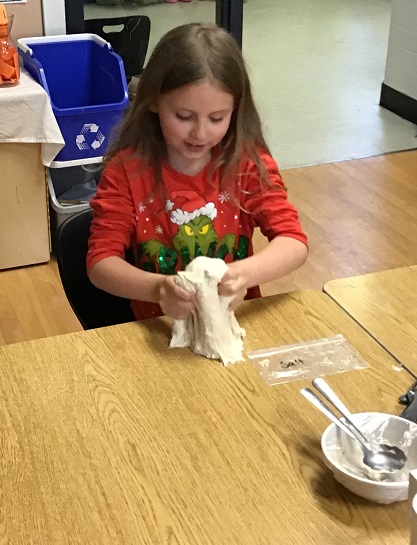
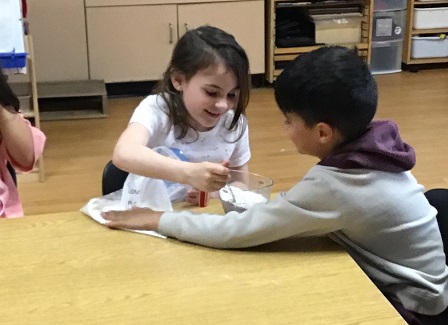
As we prepared to measure the flour, we explored the measuring cup together and identified where the 2-cup mark was located. Each child was given a turn to scoop and add flour into the measuring cup, promoting participation, turn-taking, and cooperation. When the final child added their scoop, we noticed that the flour did not quite reach the full 2-cup line. We paused to think together and asked the children how much flour they believed we had measured. "One and two thirds!" several children called out in unison, demonstrating their emerging mathematical thinking, and understanding of measurement concepts. The children also took turns chopping and kneading the dough. They used their hands and tools with enthusiasm, strengthening their fine motor skills while exploring how the dough changed as it was mixed and worked. Throughout the experience, the children showed patience, teamwork, problem-solving, and confidence as they contributed to each step of the recipe.
This baking experience supported the children's learning in many ways, including early math skills, sensory exploration, language development, and cooperative play. Most importantly, the children took pride in working together to create something delicious to enjoy as a group. Baking experiences provide meaningful opportunities to support cognitive development in children during the middle years, particularly in the areas of measurement, capacity, and mathematical thinking. As children measure ingredients, compare amounts, and observe changes in quantity, they begin to develop a deeper understanding of concepts such as volume, estimation, fractions, and number relationships.
Using tools like measuring cups and spoons encourages children to recognize numerical symbols and make connections between abstract math concepts and real-life experiences.
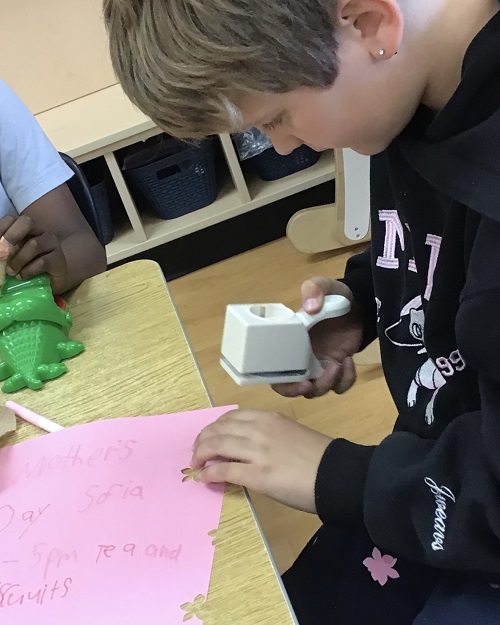
The next day, the children engaged in a meaningful literacy and art experience as they created special invitations for our upcoming Mother’s Day Tea Social.
The children designed and decorated their invitations using a variety of stamp cutters, exploring different shapes and paper colours to make each invitation unique and personal. As they worked, the children demonstrated creativity, fine motor control, and focus while pressing and arranging the stamps. Many children experimented with spacing, repetition, and design placement, showing confidence in expressing their own ideas through art.
The children also explored print awareness and early writing skills as they helped compose and write the message, “Mother’s Day Tea Social 4–5, tea and biscuits.” Some children copied letters independently, while others identified familiar words, recognized letters. Through this experience, the children developed an understanding that print carries meaning and can be used to communicate important information to others in the form of inventions and letters.
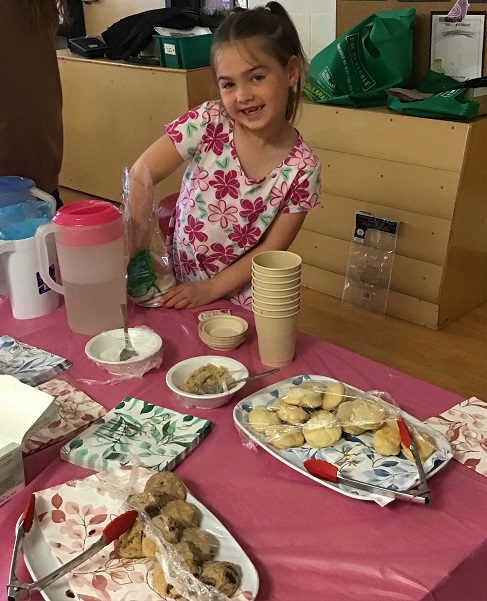
Then came the day of the Mother’s Day social. The children helped the educators set up a table cloth, the tray of homemade biscuits and our tea options. The children became very curious about the tea options. The wanted to know what was in it, and how it smelled. They noted the sweet, earthy and aromas comparing it to oranges, pomegranates, grass and vanilla.