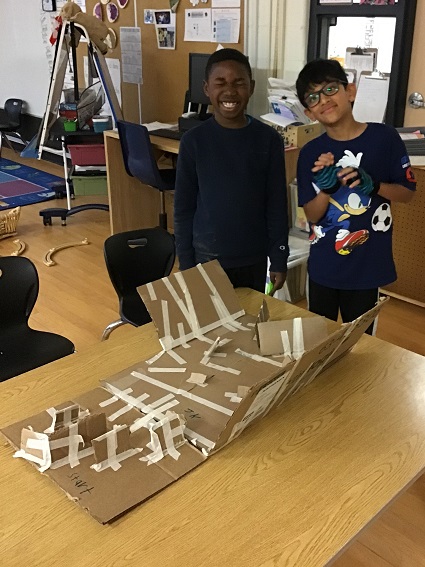
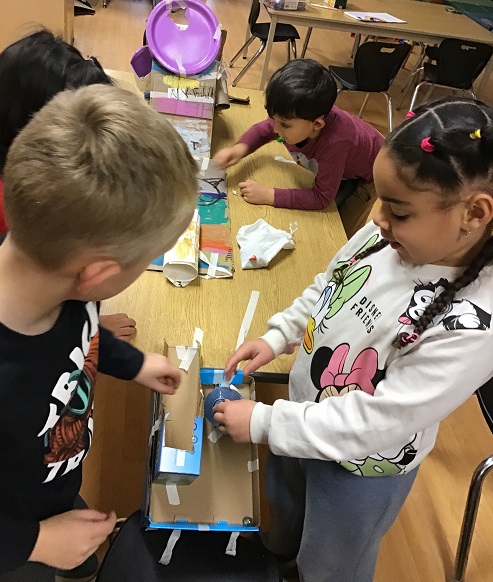
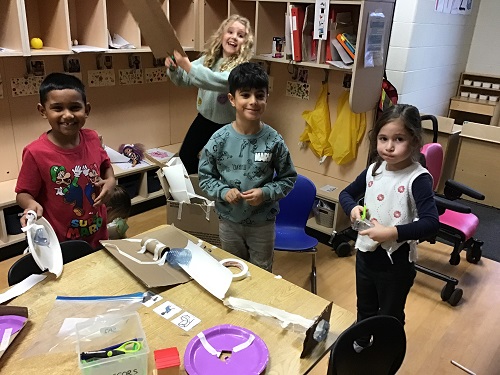
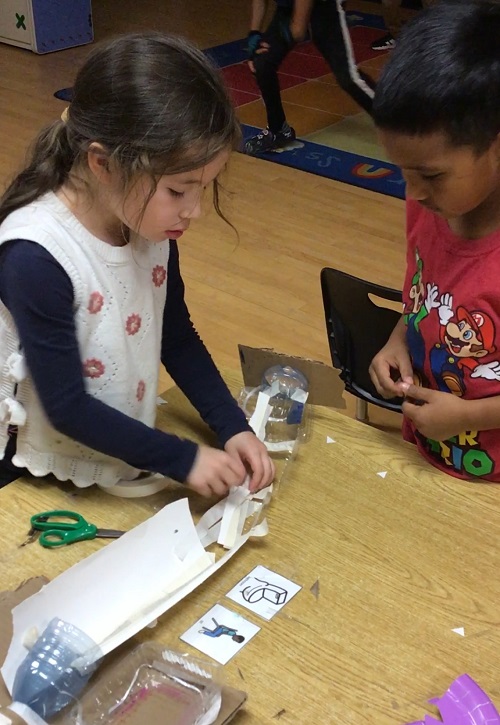
The educators observed that the group has a strong fascination with the building materials already available on our cart, such as magnetic tiles, the “Build a Robot” set, and bracelet-making beads. Each of these activities encouraged important STEM concepts: magnetic tiles supported engineering and spatial awareness, robot building promoted problem-solving and creativity, and bead crafting involved pattern recognition and fine motor skills.
To build on this growing interest in construction and design, we decided to introduce the marble run to the cart. This open-ended activity included loose wooden pieces, blocks, and chimes that could be arranged in countless ways, encouraging children to be inventive and experimental. The children collaborated closely by testing ideas, planning, adjusting, and celebrating each successful run.
To further develop the children skills promoted by STEM concepts, the educators thought, “what if we built our own marble runs using recycled materials?” When we presented this idea to the children they became very excited and eager to get their hands on the cardboard, tape and various containers.
They split themselves into groups and collaborated on a design. All the children were respectful of their peers’ ideas and found ways to incorporate individual concepts into one large marble run. Without any educator intervention the children made sure everyone was represented.
“We should colour this area pink, because some of the girls on our team would like that,” said Nirvair who considered his team mates preferences because they were not there to voice their opinions as they had already gone home for the day.
During the creation process, they experimented with their marble run, designing a creative network of ramps, panels, and bridges that sent their marbles twisting and turning in new directions. They carefully positioned panels to redirect the marble’s path, some added bridges to help it travel across open spaces. While others incorporated a funnel that sent the marble swirling before dropping into the next section. A few designs had baskets at the end to catch the marbles to complete the run.
On the last day of construction, each group was given 10 minutes to finish their creations before we started the official run with marbles. They raced against time, rushing to grab some last-minute materials. As the time counted down and narrated each minute that passed, the children squawked, screamed and groaned feeling the pressure.
Then it was time to test their final DIY run. They proudly described all their components to the educator. Then they were handed a marble.
When the marble was released at the starting point, the children watched intently.
“It’s going!” shouted Isaiah as the marble rolled down the starting point.
“It slowed down here,” observed Catalina, bending closer to see why.
Cheers erupted as it made it all the way to the bottom cup.
What learning was happening?
STEM thinking**: experimenting with gravity, angles, speed, and cause-and-effect
Creativity and innovation**: designing pathways using unconventional materials
Sustainability awareness**: re-purposing recycled items into purposeful creations
Social skills**: negotiating roles, listening to peers, and working as a team
Resilience and persistence**: testing, failing, adjusting, and trying again
By the end of this project, the marble run had become more than a construction—it was a shared achievement that reflected the children’s curiosity, patience, and collaborative spirit. They were proud of what they had created.
The educators were even more proud of how they worked together to bring their ideas to life.